

Quick Answer
Egg freezing, or oocyte cryopreservation, works by stimulating the ovaries to produce multiple mature eggs in a single cycle, collecting these eggs through a minor surgical procedure, and freezing them using vitrification technology that preserves cellular integrity. Frozen eggs can later be thawed and fertilized through IVF when you're ready to pursue pregnancy. The process preserves egg quality at your current age, though it doesn't guarantee future pregnancy, success depends on egg quality, quantity frozen, and subsequent fertilization and embryo development.
Step 1: Initial Consultation and Fertility Assessment
Egg freezing begins with a comprehensive fertility evaluation. Your doctor will review your medical history, discuss your reproductive goals, and explain realistic expectations. This is informational, not a commitment to proceed.
Key assessments include AMH testing (indicating ovarian reserve), additional hormone tests (FSH, estradiol, thyroid), and an antral follicle count (AFC) ultrasound. Together, these predict how many eggs might be retrieved per cycle.
At Proactive For Her, consultations prioritize education and autonomous decision-making in a fully confidential environment.
Step 2: Ovarian Stimulation
Because only one egg naturally matures per cycle, hormone injections stimulate the ovaries to develop multiple follicles simultaneously, maximizing eggs retrieved in a single cycle.
Daily self-administered injections (subcutaneous, using small needles) typically last 10–14 days, containing gonadotropins plus medications to prevent premature ovulation. Most women find the experience more manageable than expected. Nursing support, injection training, and ongoing guidance are provided throughout.
Step 3: Monitoring
Ultrasounds every 2–4 days track follicle growth (mature follicles reach 18–22mm), while blood tests monitor estrogen and LH levels. This ensures safety, prevents ovarian hyperstimulation syndrome (OHSS), and times retrieval precisely.
Most appointments are brief (15–30 minutes) and available early morning or evening to accommodate schedules.
Step 4: Egg Retrieval
Retrieval takes 15–30 minutes under IV sedation or light anesthesia, you feel no pain during the procedure. A thin needle guided by ultrasound aspirates fluid from mature follicles, and embryologists immediately identify eggs under a microscope.
You go home the same day after 1–2 hours of recovery. Most women return to normal activities the next day, with mild bloating or cramping possible for 1–3 days. Despite being the most feared step, it's typically the least physically difficult part of the process.
Step 5: Freezing and Storage
Mature eggs are vitrified (ultra-rapidly frozen) within hours of retrieval, preventing ice crystal formation that could damage cells. They're stored in liquid nitrogen at -196°C, where cellular aging stops completely. Eggs frozen for 10+ years show similar viability to recently frozen ones.
Modern vitrification yields 85–95% egg survival rates after thawing. Eggs remain in storage until you decide to use, donate, or discard them. Annual or multi-year storage fees apply.
What Happens When You Want to Use Frozen Eggs?
Using frozen eggs involves several steps beyond thawing, this is important to understand when setting expectations.
The thawing process involves removing eggs from liquid nitrogen storage, slowly warming them to room temperature, and assessing survival. As mentioned, 85-95% of properly frozen eggs survive thawing. Eggs that don't survive show clear cellular damage and are discarded.
Fertilization through IVF is necessary because frozen eggs must be fertilized through ICSI (intracytoplasmic sperm injection), where a single sperm is injected directly into each egg. This differs from natural conception and ensures optimal fertilization of previously frozen eggs.
Embryo development and transfer follows fertilization. Successfully fertilized eggs develop into embryos over 5-6 days in laboratory culture. Healthy embryos are then transferred into your uterus during a precisely timed window for implantation. Remaining healthy embryos can be frozen for future transfer attempts.
Many women assume frozen eggs equal guaranteed pregnancy. The reality involves multiple steps, thawing survival, successful fertilization, embryo development to transferable stage, successful implantation, and ongoing pregnancy. Each step has associated success rates that multiply to determine overall pregnancy chance per frozen egg. This is why freezing adequate numbers matters.
How Long Does the Egg Freezing Process Take?
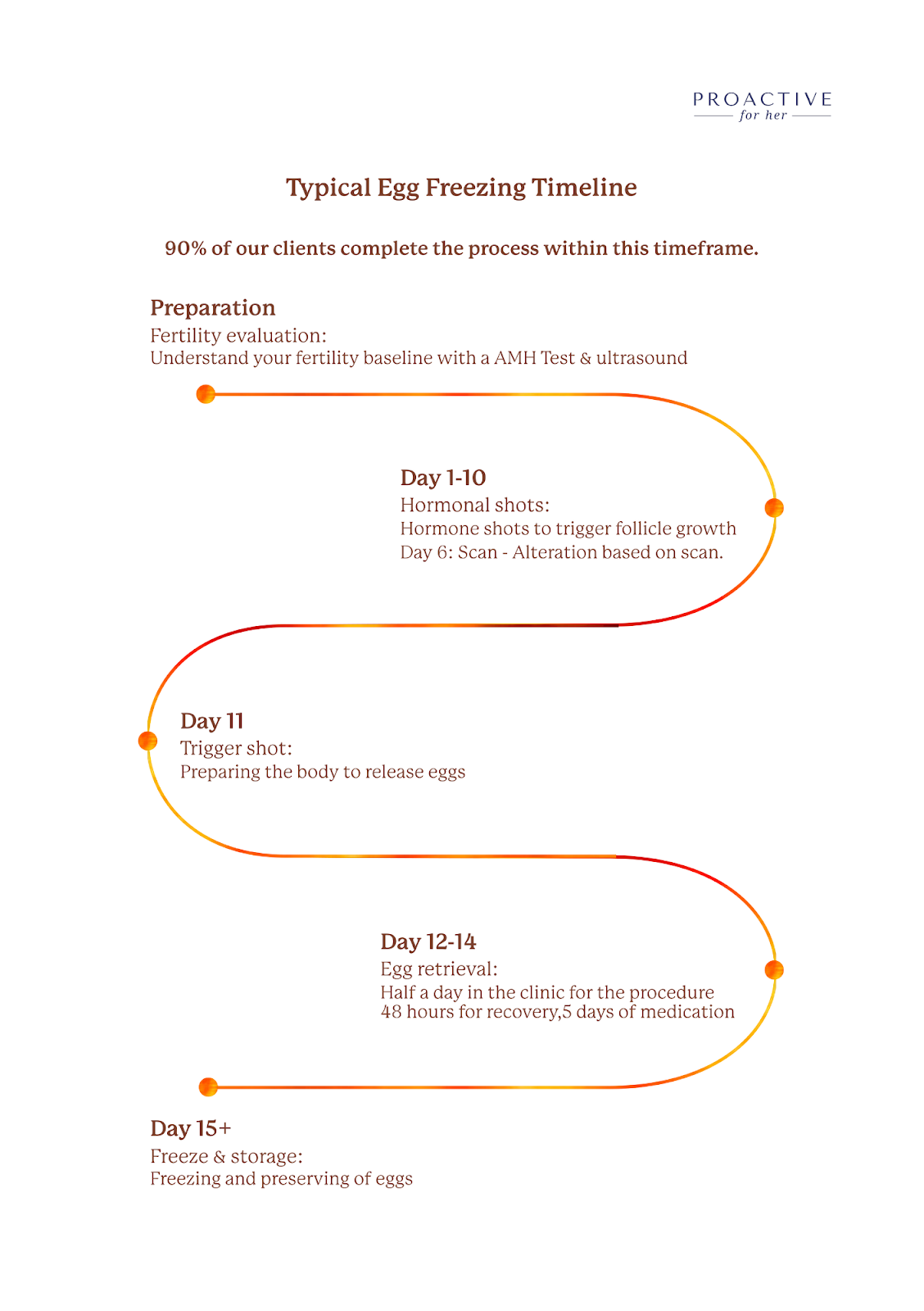
The complete egg freezing timeline involves several weeks from initial assessment through egg retrieval.
Typical timeline spans 2-4 weeks total, including initial consultation and testing (1 week), waiting for appropriate cycle start (variable timing), ovarian stimulation phase (10-14 days), and egg retrieval and recovery (1-2 days).
Variations by body response affect duration. Some women respond quickly to stimulation medications, ready for retrieval by day 10. Others require longer stimulation, 12-14 days or occasionally more, for adequate follicle maturation. Individual variation is normal and doesn't indicate problems.
Planning around work and life requires flexibility primarily during the stimulation and monitoring phase when frequent appointments occur. Retrieval requires the procedure day off and potentially the following day depending on how you feel. Most women manage egg freezing while working, though demanding travel schedules or inflexible work situations create challenges.
Timeline uncertainty causes stress for many women who prefer precise schedules. The biological variability inherent in ovarian response means exact scheduling isn't possible, protocols adapt to individual response rather than following rigid timelines. This flexibility optimizes outcomes but requires tolerance for some uncertainty.
Is Egg Freezing Safe?
Safety considerations address both the egg freezing process itself and long-term health outcomes.
Safety of hormone medications has been extensively studied through decades of IVF practice. Short-term side effects may include bloating, mood changes, breast tenderness, and headaches, typically mild and resolving after retrieval. The main medical risk is ovarian hyperstimulation syndrome (OHSS), where ovaries over-respond to medications. Careful monitoring largely prevents severe OHSS, which occurs in less than 2% of properly monitored cycles.
Safety of egg retrieval involves standard surgical risks, infection, bleeding, or organ injury, occurring in less than 1% of procedures. The minimally invasive nature, ultrasound guidance, and experienced physicians minimize these already-rare complications.
Long-term health data shows no increased cancer risk from fertility medications based on extensive follow-up studies, no impact on age of menopause or future natural fertility, and no negative effects on overall health or longevity. Eggs remaining in your ovaries after retrieval continue functioning normally.
Egg freezing is routine fertility practice, not experimental technology. Global data from millions of cycles provides robust safety evidence. Balanced risk assessment compares egg freezing risks to other medical procedures and natural pregnancy risks rather than assuming any medical intervention carries unacceptable risk.
Why Proactive For Her for Egg Freezing
Proactive For Her provides egg freezing as part of comprehensive women's reproductive health services across seven Bangalore locations, having served over 50,000 women across reproductive, sexual, and mental health services.
What distinguishes the egg freezing process at Proactive For Her:
- Doctor-led counseling providing step-by-step explanation before starting cycles
- Personalized stimulation protocols based on individual ovarian reserve and response prediction
- Comprehensive injection training and ongoing nursing support throughout stimulation
- Frequent monitoring ensuring safety and protocol optimization
- Pain-managed retrieval under appropriate sedation with experienced physicians
- Integration with mental health support addressing decision-making stress and process anxiety
- Transparent communication about what to expect at each stage
- Non-judgmental, pressure-free environment respecting autonomous decisions
Many women report that understanding the detailed process reduced their anxiety significantly, knowing exactly what happens removes fear created by uncertainty and imagination. At Proactive For Her, process transparency and patient education are prioritized throughout egg freezing journeys.
For detailed egg freezing consultation explaining the process specific to your situation, contact Proactive For Her or visit any of seven Bangalore clinic locations.
Frequently Asked Questions
Q: How exactly does egg freezing work?
A: Egg freezing works through ovarian stimulation with hormone injections for 10-14 days, egg retrieval under sedation collecting mature eggs, and immediate vitrification (ultra-rapid freezing) preserving eggs in liquid nitrogen storage. When you want to use frozen eggs, they're thawed, fertilized through IVF, developed into embryos, and transferred to your uterus for potential pregnancy.
Q: Are injections mandatory for egg freezing?
A: Yes, injections are mandatory for egg freezing because ovaries must be stimulated to produce multiple mature eggs in one cycle instead of the single egg that naturally develops monthly. Injections are self-administered subcutaneously using small needles over 10-14 days. While anxiety about injections is common, most women find the actual experience manageable with proper training and support.
Q: Is egg retrieval painful?
A: Egg retrieval is not painful during the procedure because it's performed under IV sedation or light anesthesia, you're asleep and feel nothing. Some women experience bloating or cramping for 1-3 days afterward, typically manageable with over-the-counter pain medication. The combination of sedation and brief procedure duration makes retrieval often less difficult than anticipated anxiety suggests.
Q: How long does the egg freezing process take?
A: The complete egg freezing process takes 2-4 weeks from initial consultation through egg retrieval, including testing and cycle coordination (1 week), ovarian stimulation with monitoring (10-14 days), and retrieval with recovery (1-2 days). Timeline varies based on individual response to medications, some women need 10 days of stimulation while others require 14+ days for optimal follicle maturation.
Q: What happens to eggs after freezing?
A: After freezing, eggs remain in liquid nitrogen storage at -196°C where they can stay indefinitely, studies show eggs frozen for 10+ years have similar viability to recently frozen eggs. Eggs stay in storage until you decide to use them for pregnancy attempts through IVF, continue storing them, donate them, or discard them. Annual or multi-year storage fees apply.